What Website Usability Testing Is
Usability testing puts a real task in front of a person and watches what they do. The Nielsen Norman Group describes the method as having participants complete realistic tasks while an observer notes where they struggle. The value is not the opinion a person gives afterward. It is the gap between what you assumed they would do and what they did.
For a website, the task is usually one of a handful: find out what you sell, work out what it costs, decide whether to trust you, and take the next step. Usability testing tells you which of those steps quietly fails.
- Test the path that earns money first: landing page, pricing, sign-up or booking.
- Give each tester one goal and watch what they do before you ask what they think.
- About five users per audience finds most problems. Test again after fixing.
- Pick the method by the question: real users for depth, analytics for scale, synthetic users for a fast first read.
Methods You Can Use
| Method | How it works | Strength | Limit |
|---|---|---|---|
| Moderated test | A researcher watches a participant live and asks follow ups | Deep understanding of why | Recruiting, scheduling and time per session |
| Unmoderated test | Participants complete tasks alone and are recorded | Faster and cheaper than moderated | No follow up questions |
| Analytics and session replay | Review what real visitors already do | Real behavior at scale | Needs traffic. Shows what, not why |
| Expert review | A specialist checks the site against heuristics | Quick and structured | Opinion, not observed behavior |
| Synthetic user test | AI personas use the live site in a real browser and record where they stall | No recruiting, no traffic, fast | Not real people. Confirm key findings |
Most teams settle on a pairing: a fast method to find candidate problems, and a slower one to confirm the ones that matter. If you have no traffic yet, analytics cannot help, so the pair is usually synthetic testing and a few real users. If you have traffic, add session replay for the pages that lose people.
What To Test On A Website
Work from the visitor's questions, in order. Each is a place a site tends to fail.
- Do I understand what this is?Can a first time visitor say what you sell and who it is for after five seconds on the landing page?
- Do I trust it?Is there proof, a real name, clear policies and a way to contact someone?
- Can I find the price?Is it where they look for it, and does it say what the price buys?
- Do I know what happens next?Is the next step visible, labeled with the action and free of surprises?
- Can I finish?Does the form, booking or checkout work on a phone, with a distracted thumb?
How Many Users You Need
The most quoted answer comes from the Nielsen Norman Group: about five users uncover most of the usability problems in a design, and further users mostly repeat what you already saw. Their caveat matters as much as the headline. It applies to one audience. A site that serves several distinct groups needs a few testers from each.
The same logic applies to synthetic personas. Five personas who all want the same thing find the same problems. Give each persona a different reason for visiting, a different device and a different level of technical skill, and the same five find more.
Problems Usability Testing Finds Again And Again
- A headline that describes the company, not the benefit. Visitors cannot say what you do.
- Pricing hidden or unexplained. A number with no sense of what it includes, or no number at all.
- A primary button that does not look like one. Or two buttons that compete.
- Forms that ask too much too soon. Fields that make a visitor stop and wonder why you need them.
- Mobile layouts that hide the action. The button is below a fold the visitor never scrolls past.
- Error messages that say nothing. A failed step with no reason and no way forward.
- Missing answers. The one question that decides the purchase is not on the page.
How To Run A Website Usability Test
- Write one goal per testerNot "explore the site". Something like: you run a small bakery and need online ordering. Find out whether this product can do it and what it costs.
- Recruit people who resemble your buyersFriends who know your product tell you nothing about a first visit.
- Observe before you askLet them work in silence. Note where they pause, scroll back or click something that does nothing.
- Ask what they expectedAfter a stall, ask what they thought would happen. The gap is the finding.
- Rank by how many hit itA problem three of five testers hit comes before a problem one tester mentioned.
- Fix, then test againA second round shows whether the fix worked and what the first problem was hiding.
A Faster First Read With Synthetic Users
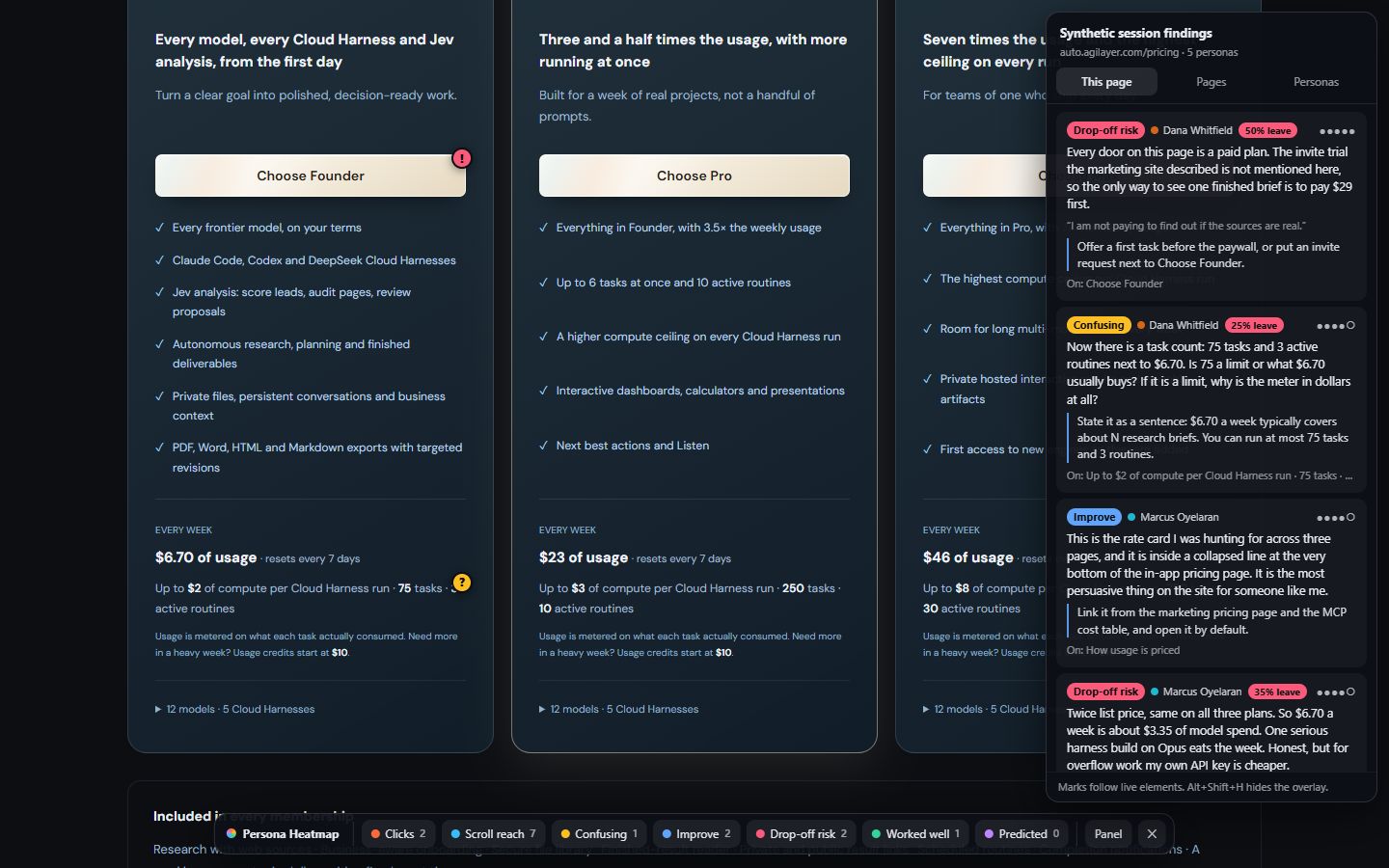
Recruiting is the slow part of usability testing. Synthetic user testing removes it: AI personas built around your customer segments use your live site in a real browser, and the test records their clicks, scrolling and reactions. You get a ranked list of findings and a heat map drawn on your own pages.
It is a first read, not a verdict. Personas are more patient than real visitors, and they cannot tell you what a real person feels. Use the findings several personas share to decide what to fix now and what to check with real users.
What You Should Get Back
A usability test is only as useful as what it hands you. Look for findings tied to a page and an element, ranked by severity, with the number of testers who hit each one, the tester's own words and a suggested fix. Our guide to the website UX audit and report covers what a good report contains.
Test your website this week. Personas tuned to your ideal customers, a heat map and ranked fixes in 24 to 48 hours.
Order A TestFrequently Asked Questions
What Is Website Usability Testing?
It is a research method where people try to complete realistic tasks on a website while you observe where they succeed, struggle or give up. The goal is to find the specific things that stop visitors from understanding the site or finishing what they came to do.
How Many Users Do I Need For A Usability Test?
The Nielsen Norman Group recommends about five users for one audience, because most problems show up quickly and later users repeat them. If your site serves several distinct groups, test each group separately. Several small rounds with fixes between them beat one large round.
What Should I Test On My Website?
Start with the path that earns you money: the landing page, the pricing page, the sign-up or booking flow and the first thing a customer does afterward. Give each tester one clear goal, such as finding the right plan and starting a trial.
What Is The Difference Between Usability Testing And A UX Audit?
Usability testing observes people using the site. A UX audit is a structured review of the site against known principles and data, usually by an expert or a tool. Audits are quicker. Testing shows what actually happens. See the guide to the website UX audit for how they fit together.
Can I Test A Website Without Real Users?
Yes, for a first read. Synthetic user testing uses AI personas to use your live site and record where they get stuck. It needs no recruiting and no traffic, but it is not a replacement for real users on the findings that matter most.
How Often Should I Run Website Usability Testing?
Run a test before launch, after any redesign or change to pricing, sign-up or navigation, and whenever conversion drops for no clear reason. For a site that changes often, a quick synthetic test before each release is cheaper than discovering the problem from lost customers.